Videographers
How Videographers Can Outsource Editing Without Losing Their Style
How videographers can outsource editing and keep their look: what to hand off, what to keep, how to package footage and how to test an editor first.
You can outsource editing as a videographer and keep your style, but only if you hand over the style along with the footage. That means reference films, your colour settings, music rules and a clear definition of "done". Start with one small paid test, keep the final review in your own hands, and hand off the slow, repeatable work first: selects, sync, rough cuts and vertical cutdowns.
Most videographers who get burned by an editor didn't pick a bad editor. They sent a hard drive and a sentence. Here's how to do it properly.
Why videographers outsource editing in the first place
For most videographers, shooting pays and editing is where the week disappears. A one-day shoot can turn into several days in the timeline, and while you're cutting you're not booking, shooting or pitching.
Outsourcing doesn't make sense for everyone. If editing is the part of your work that clients actually pay a premium for, and your edit is your signature, keep it. If editing is the bottleneck that stops you taking the next job, it's worth handing some of it off.
A good test: look at your last month. If you turned down a shoot, delivered late or skipped the social versions a client asked for because the timeline was full, editing is your bottleneck.
What to hand off and what to keep
Don't outsource everything on day one. Start with the work that has clear rules and takes the most hours. Keep the decisions that define your look until the editor has earned them.
| Task | Hand off early? | Why |
|---|---|---|
| Logging, selects and stringouts | Yes | Pure time. Easy to check |
| Audio sync and multicam setup | Yes | Rules-based. Mistakes are obvious |
| Rough cut from your brief | Yes | You still shape the final story |
| Captions and subtitles | Yes | Repetitive and easy to check |
| Vertical cutdowns (Reels, TikTok, Shorts) from a horizontal shoot | Yes | High volume, and often the work you'd otherwise skip |
| Colour grade | Later | Hand it off once your LUTs and references are documented |
| Music choice | Later | Licensing and taste. Set clear rules first |
| Final review and client delivery | Keep | This is your name on the work |
The vertical cutdowns row is worth a second look. Plenty of clients now want social versions of every shoot, and those edits are where a lot of videographers either lose a weekend or leave money on the table. Handing them off is often the easiest first step, because the main film is already approved and the cutdowns follow it.
Send your style, not just your footage
An editor can't match a look they've never seen. Before the first project, put together a short style pack:
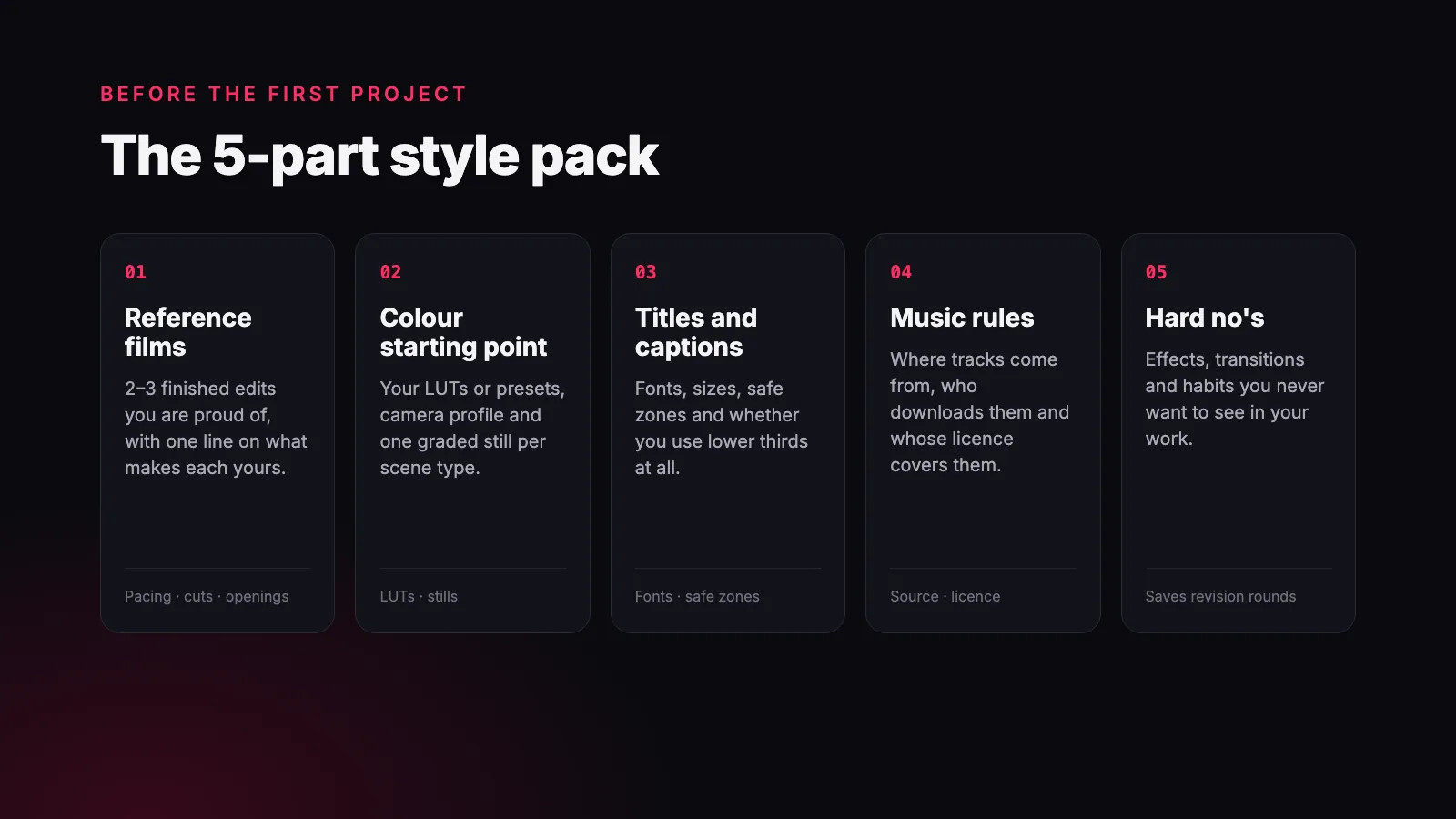
- 2–3 finished films you're proud of. The edits you want the new work to feel like, with a line on what makes each one yours: pacing, where you cut on music, how you open.
- Your colour starting point. The LUTs or presets you use, the camera profile you shot in, and one graded still per scene type.
- Title and caption rules. Fonts, sizes, safe zones, and whether you use lower thirds at all.
- Music rules. Where the music comes from, and who downloads it. If the track licence sits on your account, you'll probably need to supply the files yourself. Check your licence terms before you share log-ins.
- Hard no's. Effects, transitions or habits you never want to see. This list saves more revision rounds than anything else.
Then add a written brief for each project: who the film is for, how long it should be, the must-have moments and the delivery formats. Our free video editing brief template has both parts ready to fill in.
Package the footage so the editor can start in minutes
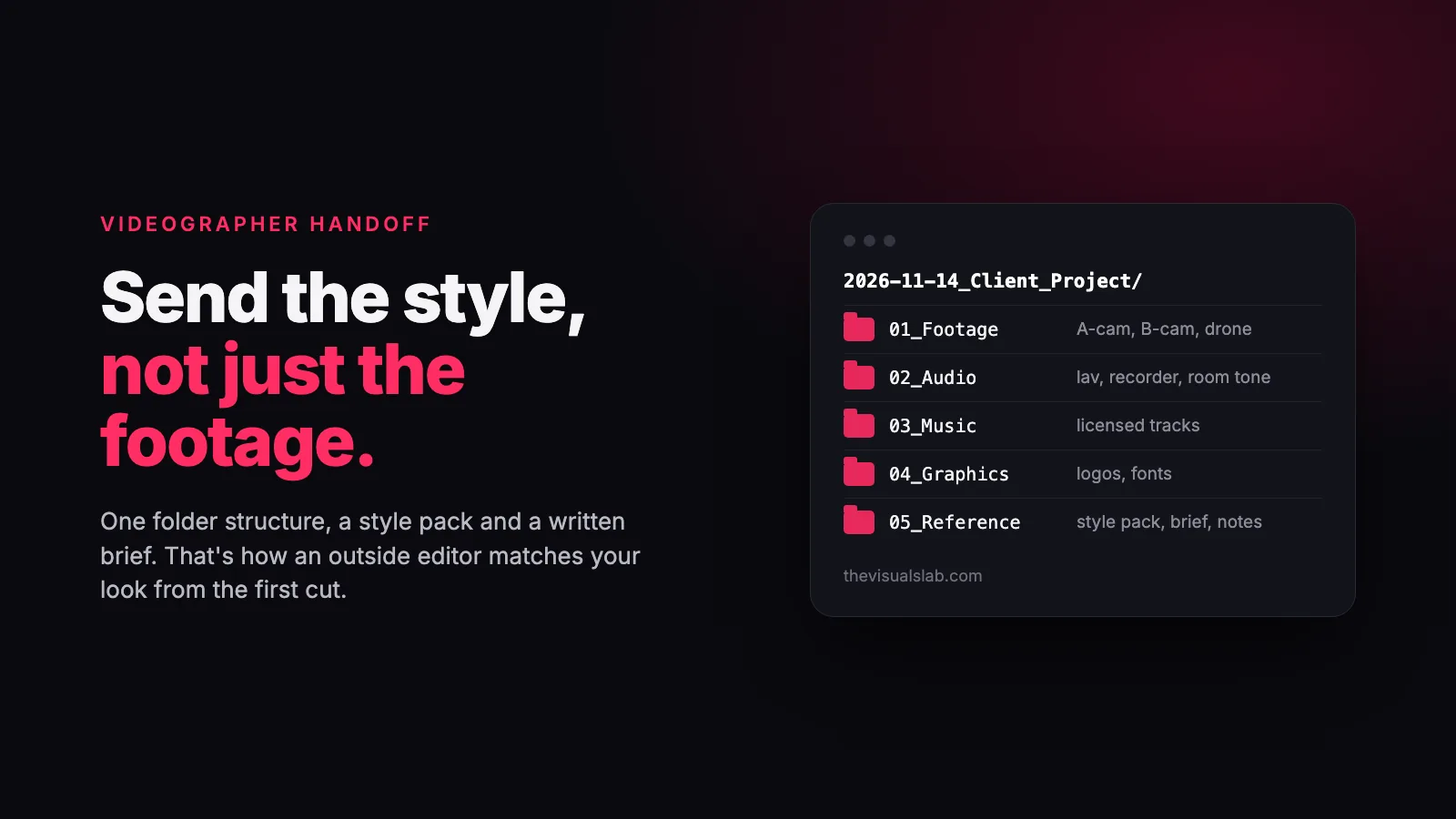
A messy drive costs you money twice: once in the editor's hours, and again in the revision round when they used the wrong take. Use the same folder structure on every job:
2026-11-14_ClientName_ProjectName/
  01_Footage/   (A-cam, B-cam, drone, one folder each)
  02_Audio/     (lav, recorder, room tone)
  03_Music/
  04_Graphics/  (logos, fonts)
  05_Reference/ (style pack, brief, shot notes)
Add a short text file in 05_Reference that names the best takes and anything to avoid. Two minutes of notes like "interview cam B has the better framing after 14:20" can save an hour of searching.
If upload speed is a problem, agree on the workflow first: whether you send full-resolution files or proxies, and who relinks to the originals for the final export.
Use a proper review tool, not email threads
Feedback in email turns into "the bit near the start where she laughs". Use a review link with timestamped comments instead. On Frame.io, for example, reviewers can leave comments pinned to a timecode or a range and draw directly on the frame (Frame.io: share links explained). Each new cut can be stacked as a version on top of the last one, so nobody reviews an old export by mistake (Frame.io: versioning).
Whatever tool you use, the rule is the same: one place for feedback, one comment per change, and a clear "approved" moment. Write comments as instructions, not reactions: "cut 1 second earlier, on the downbeat" gets fixed in one round; "feels slow" starts a conversation.
Test an editor before you trust them with a client
Don't start with your biggest client's launch film. Start with a paid test on real but low-risk footage, ideally something you've already edited yourself. Then you can compare their cut to yours.
Judge the test on four things:
- Did they follow the brief without you repeating it?
- Does it feel like your work: pacing, colour, music placement?
- How did they handle feedback: fixed in one round, or the same notes twice?
- Did they ask good questions before starting, rather than guessing?
If two of the four are weak, move on. Style can be taught. Not reading the brief usually can't.
A simple weekly handoff routine
Once an editor passes the test, a fixed routine keeps quality steady:
- Upload by the end of the shoot day, into the same folder structure every time.
- Send the brief the same day, even if it's five lines.
- Review the first cut within 24 hours, in one sitting, with all comments in the review tool.
- Approve or send one round of notes. If a second round is needed, ask why the first one missed, and update the style pack.
- Deliver to the client yourself, after your own final check.
The routine matters more than any single edit. It's what lets you take more shoots without the quality slipping.
Common mistakes videographers make when they outsource
- Sending footage without references. The editor guesses your style and you spend the revision round teaching it.
- Giving feedback in five places. WhatsApp, email and a call recap mean notes get missed.
- Handing off the grade on day one. Colour is personal. Document it first.
- No written terms. Agree on confidentiality, revisions and turnaround before the first job, not after a problem.
- Judging on price alone. A cheaper edit that needs three rounds costs more of your time than a good one that needs one.
Keep the client relationship yours
If your clients hire you, they don't need to know who edits. That's what white-label editing means: the editor works under your name, never contacts your client, and doesn't post the work without your permission. Agree on that in writing before the first project: confidentiality, no client contact, who owns the files, revisions and payment. Our page on confidentiality and NDAs shows how we handle it.
Freelancer or editing team?
A single freelancer can be great: one person who learns your taste. The risk is capacity. When they're sick, booked or gone, your delivery dates go with them. A team costs more per edit but gives you cover and a second pair of eyes on quality. If you're shooting a few projects a month, a trusted freelancer is often enough. If you're delivering every week, or adding vertical cutdowns to every shoot, a team is usually safer.
That's the gap our video editing for videographers service is built for, and it runs on the same white-label video editing setup we use for agencies. If most of your extra work is social cutdowns, see our short-form video editing page.
How fast an outsourced editor can deliver
Turnaround depends on the format and on how ready your footage is, so agree on it per format rather than per project. Short social cuts are the quickest: with a clear brief and organised footage, 48 to 72 hours is a common standard, and it's what our monthly plans commit to. Long-form films, documentaries and anything with heavy grading or motion graphics need a date agreed before the edit starts.
Three things slow every editor down, whoever you hire:
- Missing files. A logo, a font or the licensed track arrives a day late, and the edit waits.
- A brief that changes after the first cut. New must-have moments mean a new edit, not a revision.
- Slow reviews. If the first cut sits unreviewed for three days, the project takes three days longer.
Plan your client deadlines with that in mind: add a day for your own review, and only promise a delivery date once the footage, brief and music are all in the folder.
What outsourcing editing costs
Prices vary a lot by format and volume, so compare like for like: a 60-second social cut and a 20-minute documentary are different jobs. At The Visuals Lab, monthly plans start at $897 for up to 12 short-form videos, YouTube-length edits start at $249 per video, and every price is on our pricing page. Whoever you choose, ask for the volume, turnaround and revision rounds in writing before you start.
FAQ
Quick answers to the questions videographers ask us most.
Will an outsourced editor change my style?
Only if you don't define it. Send reference films, your LUTs and a list of hard no's, then judge a paid test against your own edit of the same footage.
What should I outsource first as a videographer?
Selects, audio sync, rough cuts, captions and vertical cutdowns. Keep the final review and client delivery yourself until you trust the editor.
How do I send large footage files to an editor?
Use one consistent folder structure and a cloud transfer or shared drive. Agree up front whether you're sending originals or proxies, and who relinks for the final export.
Will my clients know I outsource editing?
Not if you work white-label. Put confidentiality and no client contact in a written agreement, such as an NDA, before the first job.
Should I hire a freelancer or an editing agency?
A freelancer suits low, steady volume. A team suits weekly delivery or high-volume social cutdowns, where one person's sick day would hurt your deadlines.
Ready to test it? Start with a Pilot Week: 5 edits for $297, with your money back if the edits miss the brief after one revision. Book a free call.